In order to lessen the attractiveness of night-flying insects, pest management experts (PMPs) have been advising their clients for many years regarding the type of lights to use and their suitable placement on the exterior of their house or place of business. As they became available, PMPs suggested clients to switch external white incandescent or fluorescent bulbs for less appealing yellow ones, as well as mercury vapor lights with less appealing sodium vapor lights. LED (Light Emitting Diode) lights for outdoor usage have just entered the market thanks to the lighting sector.
Is using LEDs for outdoor lighting a good idea? If not, why not?
What kind of light attracts insects?
Humans can perceive light with wavelengths in the 400–800 nanometer (nm) region of the electromagnetic spectrum, which runs from violet to red in hue but excludes ultraviolet (UV) light at 350 nm. While they can see in the 300–650 nm range, insects prefer the 300–420 nm range, which includes UV light. The UV output of a light is likely the most significant determinant in an insect's attraction to it. The majority of ILTs (Insect Light Traps, including bug zappers) use UV/blacklight bulbs as their source of attraction since most insects are drawn to them.
UV, blue, and green are the three primary hues of light that insects often see. Insects are especially drawn to lights that are bright white or blue (mercury vapor, white incandescent, and white fluorescent). Most insects find yellowish, pinkish, or orange hues (sodium vapor, halogen, or dichroic yellow) to be least appealing. The recommendation was to swap out the white incandescent lights for yellow insect bulbs when white incandescent bulbs were the only option. Insects are less drawn to yellow and "warm white" lights because they resemble sunshine more than "cool white" bulbs, which have a more blue hue. Even though yellow lights are less appealing to insects than red ones, red bulbs give off very little visible light to humans and have been associated with "undesirable" social stigma for many years.
Insects are drawn to light not just because of its color or wavelength, but also because of its brightness and heat. The brightness of the light and the drawing distance increase with the bulb's wattage rating. Moreover, the quantity of heat produced by lights with blazing filaments (such as incandescent, halogen, etc.) increases with increasing wattage. Less heat is produced by cool lights like LEDs, mercury vapor, sodium vapor, and fluorescents that produce light from moving gas.
Features of LED lighting
Colors of LED lights can range from ultraviolet (350 nm) to infrared (700 nm). From being extremely focused, like a laser pointer, to being widely diffused, like a flood or spot light, the light pattern emitted (angle of dispersion) can vary greatly. A LED light's brightness is determined by the current flowing through it. The bulb won't last as long even if a greater current level would result in a brighter light. When compared to incandescent bulbs, LED lights are far more energy-efficient, utilizing just 1/5 to 1/10 the power and lasting at least ten times longer. In addition to being stronger and smaller, LED bulbs often have no glass to break and lack a filament.
There are few exceptions to the rule that most LEDs don't emit much UV light (see below). Instead of creating white light, LED lights create their "white" light by mixing a number of other light hues. Certain LEDs will display one hue more prominently than the others. Insects may find "cool white" LED lights to be more alluring than warmer or more yellowish LED lights.
Do insects find LED lights to be attractive or not?
Most LED lights don't emit UV light and produce very little heat, thus insects don't seem to be attracted to them. Nevertheless, the color combination employed to create the "white" light from the LEDs may attract certain insects to one or more of the light hues. While LED lights generate little heat and emit the incorrect hues of the visible light spectrum for most insects, which is why so few insects are drawn to them, insects are attracted to light.
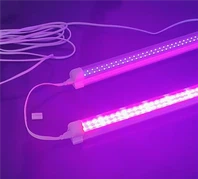
Certain LEDs, such as those used in mosquito light traps and as plant grow lights, are especially designed to emit UV light. Then there are those that are utilized to clean, sanitize, and cure certain industrial coatings (e.g., dental tooth-colored fillings, also called composite resins).
LED lamps are not always imperceptible to insects. Similar to fluorescent or halogen lamps, UV LED spotlights, cool white LEDs, and neutral colored LEDs may attract insects. For LED spotlights, warm white or off white are preferable options.
Take-home point
Most LED lights used for home illumination are only marginally interesting to insects and emit practically no UV light. Several types of insects are drawn to the blue or purple light that LEDs emit. As a result, LED lights are a wise alternative if you wish to lessen difficulties with flying insects. Although LED bulbs are now fairly expensive up front, their prices are expected to decrease with time.
selecting LED lighting
output of light
Lumens are a unit of measurement used to describe how much light an LED bulb emits. A 100 watt incandescent bulb generates roughly 1,600 lumens, in opposed to a 60 watt incandescent bulb's output of 800 lumens.
The light color
Degrees Kelvin are used to measure the color of LED bulbs (K). Lower Kelvin levels often correspond to warmer, more reddish temperatures. A bulb with a color temperature of 3500 Kelvin is akin to a halogen bulb, whereas one with a temperature of roughly 2500 Kelvin would provide light that looks like a candle. LED bulbs start to emit more scotopic lumens, or the amount of light that is seen by the human eye, in the 5000 range. While the light would appear brighter, it would not appear to be natural light. Above 6000 Kelvin produces a brilliant, but uninviting, light with a lot of blues and purples. It is recommended to use low Kelvin bulbs indoors and high Kelvin bulbs outside for illumination.